Thursday, 30 January 2014

What does your garden say about you?


‘What a strange thing to say’, was my first reaction to this quote. 

And then I thought about it and yes, there is quite a lot of my ‘autobiography’ in my garden.

There are the plants that have moved house with me, some of them many times; a constant reminder of other homes I’ve had, other cities where I’ve lived. 


As soon as I knew I was going to be leaving Hereford, I took some of the shoots that were growing around the base of the Mock Orange and put them in pots with some soil. By the time I was ready to sort out my garden in Abergavenny, they had grown roots and in next to no time I had a bush that has grown into a small tree!

And there are still a few that my mother sent to me many years ago, wrapped in damp kitchen paper and foil, from the garden of the house I grew up in. They bring back memories of childhood, when the garden seemed vast and I loved to lift up the stones in the rockery and watch the woodlice scurrying around underneath. Apparently I was so fond of woodlice that I asked a grown-up whether they, too, went to Heaven when they died. Obviously a very compassionate little girl, I felt so sorry for the grass because it didn’t have a lovely fragrance that I sprinkled it with my mother’s best perfume – or so I’m told!

The primroses I grow nowadays are the brightly coloured, showy ones that come in pots and I usually keep them on the shelf in my front porch.


This primrose pattern (below) started off as a screenprint, back in the '80s but I kept the original drawing and used it to make a repeating pattern that has become popular on greeting cards as well as mugs and phonecases.

But as a child I used to go to the woods with the Wolf Cubs – my mother was Akela! – and pick the beautifully scented wild primroses. 

I can clearly remember how they were tied in bunches and hung from long sticks that the bigger boys carried over their shoulders. And the primroses were somehow transported from the Isle of Wight, where I lived, to the East End of London, where apparently the children had never seen a copse, let alone a primrose!


So yes, there are bits and pieces of my autobiography in my garden, plants that friends have given me, sometimes to mark a special occasion, like the salmon pink geranium I was given when one of my children was born - and I expect you’re the same. 


It’s nice to reminisce but probably boring for other people to hear. 

But another similar quote I came across is perhaps more to the point and I’m not sure I like what it’s saying -


“Show me your garden and I shall tell you what you are” 
Alfred Austin

Does my garden really reveal that much about me? I would like to think it didn’t because my gardening is so haphazard that it’s a bit of a chaos really!


At first glance, people generally admire my garden – it’s usually full of colour and fragrances, as well as birds, bees and butterflies. 

But look a bit closer and it’s dreadfully untidy – a real hotchpotch of plants quietly running riot. But that’s just how I like it. I don’t like neat gardens and heaven forbid that I should ever try to constrain Nature to a straight line!


I've never been very interested in expensive plants from Garden Centres; I think you can make a very pretty and easily maintained garden using plants like Valerian, Antirrhinums and Mountain Cornflowers that some people would call weeds. I sometimes, when I have time, collect the seeds from the pods to scatter in following years. Sometimes they grow - sometimes they don't. And I certainly get my money's worth out of wallflowers! I let them stay, year after year, until they get so old and woody that they're easy to pull up.

From my bedroom window

My lawn is very long on dandelions and other weeds and short on grass. But as long as I keep it mowed in summer, it looks pleasantly green and that’s all I ask of it, especially when the weather’s dry and proper lawns are turning brown!

I don’t stick to the rules when it comes to gardening. I tend to just do what seems likely to work, as long as it doesn't take up too much of my time. Sadly, I do occasionally ‘lose’ a plant that I’m fond of, through sheer neglect. But far more often the rather ‘broad brush’ gardening techniques that I inherited from my mother – dig a hole, put plenty of water in it, spread the plants all round in a circle, fill the hole and stamp it down firmly! – produce the desired results. 

In fact I seem to have a bit of a way with dead-looking sticks that I’ve bought very cheaply. And once resurrected with a dose of TLC, they often go on to become glorious additions to my little patch.
 
I bought the 'Dreaming Spires' rose very cheaply in a supermarket, the Mock Orange was one of my transplants from my Hereford garden and the Honeysuckle was a very dead-looking stick!


As I write this, I realise that Alfred Austin has a valid point. My garden does say quite a lot about me! 


What does yours say about you?

Please feel free to pin or download and print
 this 300 dpi image (for your personal use only).

Thursday, 23 January 2014

Snowdrop Quotation to Inspire You


I love this quotation by 20th century American author, Anais Nin!

It fits so well with my belief that flowers, plants and anything that grows make the clearest metaphors for life and ‘what it’s all about’. 

I’ve never read any of Nin’s work so I don't know what sort of ‘blossoming’ she may be referring to. But that doesn't matter; there are innumerable ways in which we can all blossom – or alternatively, remain, painfully, tight in the bud!


Buskers take a very public risk!
So often fear prevents us taking the plunge, raising our heads above the parapet or however you choose to describe that moment when we show the world what we, uniquely, have to offer. 

For some of us it may be our upbringing that has held us back from being all that we know, deep down inside, that we are capable of being; or maybe it was something in our experiences at school. Or maybe we tried once before but met with failure or even ridicule.


But there comes a tipping point, when, as the quotation says, it becomes more painful to hold back than to take the risk. It has happened to me and I’m sure it will have happened to many others. Some will have been lucky enough to receive all the encouragement they needed. But even then, there were probably moments of self-doubt to overcome – few of us are totally self-confident.


Young busker in Abergavenny
Some will take the risk at an early age and live lives that are comfortably aligned with their true selves and their talents. Others, like me, take longer to be convinced that it’s worth the risk. We try all sorts of other things first, trying to avoid that fateful step from which there’s no going back, that blossoming, that ‘unfolding of our petals’. 

But it's never too late, as George Eliot wrote, to be what you might have been!

Are you one of those ‘on the brink’? Or do you know someone in that position, a friend or a relative you wish would just embrace their talents and, like the plucky little snowdrop, start to show the world what and who they truly are? 

The snowdrop doesn’t hold back from bringing beauty into our world and hope into our hearts, in spite of the worst that the winter weather can muster. 


So why do we?


Please feel free to download this A4 high-res sheet
if it will inspire you or someone you know!

 (Just click on it then right-click and 'Save as...')


Thursday, 16 January 2014

Some Welsh Saints and Symbols


No, I haven’t jumped ahead of myself with these daffodils below. 

I do know that we’re still in January and that the daffodil is rightfully the Birth Month Flower of March!

It’s just that here in Wales, there’s an earlier version of St Valentine’s Day, celebrated on January 25th - St Dwynwen’s Day. And as the daffodil is one of the national symbols of Wales, I used one of my daffodil patterns, instead of the usual roses, on the St Dwynwen’s Day greeting cards for my new Zazzle store, 'Posh & Painterly Cymru'.


You can read about St Dwynwen, and the dramatic events that are supposed to have led to her being chosen as the patron saint of lovers, here, in an earlier blogpost. And since I wrote that post, I’ve decided to make St Dwynwen’s Day greeting cards after all - and they are quite popular. 

Here's one I made last week for the Celtic Family Magazine's 'shop':


The illustration for another of my
St Dwynwen's Day Greeting Cards,
this time for sale in
the Celtic Family Magazine shop


But back to the daffodils -

The first time I ever visited Wales, on a family holiday, back in the 1970s, we couldn't help noticing the beautiful banks of daffodils along the roadsides. They seemed to be everywhere. So I assumed that they must grow particularly well in Wales and that was the reason that they are one of the national symbols.

But more recently, I’ve noticed that the daffodil banks are spreading and you can see them across England too. So what is the real reason that the Welsh have adopted daffodils as one of their national emblems? 

The reason is a mixture of legend and human error!

Legend has it that St David, the patron saint of Wales, ordered the Welsh soldiers to pluck a plant from the battleground to wear in their caps to distinguish them from the Saxons they were fighting. The battle happened to take place in a field of leeks and that accounts for why the leek is the number one Welsh symbol, though here are some variation on that theory.

That’s the 'legend' part of the story and here comes the 'human error' component! 

The Welsh word for a leek is ‘cenhinen’ and the word for a daffodil is ‘cenhinen bedr’ or ‘cenin pedr’ (Peter’s leek). So it’s easy to see how the two became confused, especially as some narcissi are distantly related to some species of leek, both being part of the alium family.

I don’t know who the ‘Peter’ was who gave his name to the daffodil in Wales, causing such confusion. If anyone knows, I’d be very interested to hear about it!


Thursday, 9 January 2014

When will the Snowdrops appear?


It’s January, and thanks to the mildness of the weather, all sorts of summer flowers, are still bravely trying to brighten the winter dreariness in my little back garden, alongside the Winter Jasmine.


As well as the roses I wrote about last week, there’s the faithful perennial wallflower, Bowles Mauve, that only seems to stop flowering for about a month in early spring. It can get a bit straggly, especially in a garden like mine that has high walls all round so it has to stretch upwards towards the light. But for sheer lasting colour, there's not much to beat it!


There are even a few of the big white Daisies left over from the summer. They look decidedly battered by the gales and sleety rain but it's good to see them even so. 

I read somewhere that their unopened buds can be pickled and eaten as capers – though I don’t recommend trying it without a proper recipe!


My unused path to the garage is covered in fallen apples, ready for the blackbirds who appreciate them when the weather turns really cold, even managing to find them through substantial layers of snow!

I don't know what kind of apples they are as they were planted by the previous owner but they're not particularly nice; so I'm happy to leave most of them for the birds.


Bulbs are beginning to push up through the earth – what energy that must take when the ground is so cold and hard! – a reminder that winter will eventually give way to spring. 

But as yet there are no snowdrops flowering. And that doesn’t surprise me – I always think of snowdrops as a February flower, followed by other bulbs, such as daffodils, from March onwards.

The poets seem to be in agreement that snowdrops put in their appearance in February. Alfred, Lord Tennyson calls them, ‘February Fair-maid’ and here’s another poetic reference, by Hartley Coleridge, that seems to suggest that February is the time when:


‘One month is past, another is begun,
Since merry bells rung out the dying year . . .

. . . The virgin snowdrop like a lambent fire,
Pierces the cold earth with its green-streaked spire.’


Another name for the Snowdrop is ‘Candlemas Bells’, Candlemas being on February 2nd and you can read more about this plucky little flower here. 


You may need to click on this print to see the snowdrops, just tiny flecks of white in the grass, and I know I painted this riverbank landscape from a photo that I took in February. So that settles it, snowdrops bloom in February.

But no, somewhere someone has decided that they bloom in January!

I had a bit of a shock, a couple of Februaries ago, when I started to think about making a ‘snowdrop’ design, based on a screenprint I'd made years ago, for my daughter’s birthday on February 17th. I knew that there were ‘Birth Month Flowers’ – I’d seen the categories on Greeting Card Universe - and assumed that Snowdrops would feature in February. I used the internet to look up the various birth month flowers and to my amazement found that the snowdrop is the flower assigned to January! 

So, if you’re stuck for an original birthday card for someone born in January, this might fit the bill - 


On the other hand,
 if you are just looking for cards with snowdrops, 
you'll find a whole bunch of them

Thursday, 2 January 2014

Christmas Roses - Blooming Late Against the Odds!


Rosebud against the
 frosted rooftiles
Back in August, an old friend came to visit and I asked him if he would mind holding my tall steps steady while I dead-headed some climbing roses that had grown way out of my reach.

He kindly agreed but somehow I found myself holding the steps while he attacked my roses far above my head. When I stood back and saw how ruthlessly he had savaged them, I feared he'd overdone it – until just before Christmas, when I noticed, in the fading afternoon light, some bright little spots of pink glowing high up against the dark of my garage roof! 

In spite of the horrendous weather, the roses were not only well and truly alive - they were in bud!

So a couple of weeks later, when my very tall son came down for Christmas, I asked him to reach up and pick the rosebuds for me. And here they are, amongst the cones and candles, decorating our Christmas Dinner Table –


I usually prefer flowers when they are in season, just as I think fresh vegetables taste all the better for being genuinely 'fresh'! 

But I also see plants, particularly flowering ones, as a metaphor for our purpose in life - to grow, to bud, to blossom and finally to bear fruit, of one sort or another, which will, we hope, contain within itself the seeds of what we leave of ourselves for later generations!

With that in mind, I have to admire these beautiful rosebuds that bloomed so late in the year, in spite of severe winter storms; storms that cut the power lines and flooded homes, alternating with frosts that left the nearby roof tiles sparkling white with frost!

This Chinese proverb sums it up perfectly, I think:

"The flower that blooms in adversity is the rarest and most beautiful of all."

.......


Click
for more 
ROSES,
including gifts and greetings
for sale in my online stores.

Wednesday, 1 January 2014

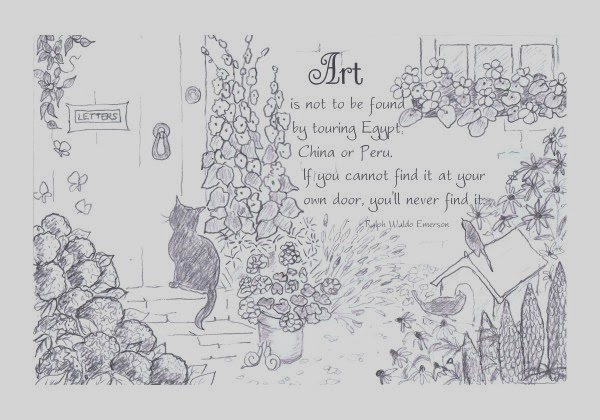
Finding Art on your Doorstep

Doodled beginnings of an illustration of the Emerson quote

“Art is not to be found by touring to Egypt, China or Peru; if you cannot find it at your own door, you will never find it.” Ralph Waldo Emerson.

Some twelve years ago I decided to see how I got on with trying to sell my pastel paintings, in effect ‘coming out’ as an artist. 

When I told a friend about this, her immediate, excited reply was to tell me how lucky I was because this would mean that I could go to Venice. Although Venice is one of the few places I would love to spend some time, I was totally at a loss to see the connection between trying to make a living from my art and going to Venice. 

I still am – and I was delighted to come across Emerson’s quote because it expresses my own approach to art. I don’t believe that we need to travel to find inspiration; for me at least, inspiration can strike at any moment, no matter where I am or how familiar or apparently 'ordinary' my surroundings.

I might suddenly notice the play of the light on the lace curtains in my bedroom –


- or, probably more often, something outdoors, in my local area or especially in my little garden, simply begs me to paint it or to make it the basis of a pattern or greeting card design:

Lipstick Pink Roses

Periwinkles

Tulips in the park I cross each time I go shopping


So, over the coming months, I plan to introduce you to the ‘art’ that I've found ‘at my own door’ – or perhaps just a little bit further afield - beginning, tomorrow, with some Roses at Christmas:


PS By trial and error, I've learnt a valuable tip today! Next time I attempt to illustrate a quotation, I'll definitely make things much easier for myself if I put the text in place first and illustrate around it!


.......


Click
for some of the
Gifts and Greetings for Gardeners
that I've designed

Sunday, 29 December 2013

Promoting your Online Stores - 6 Tips


Those of us who sell our artwork through online stores know all too well that the secret of success is to make sure our work gets seen by the buying public. 

And, given the sheer vastness of the internet and all that it contains, that can seem like an impossible task. I’m no marketing expert but I have picked up a few tips from people who are and, by trial and error, I’ve worked out a few guidelines that I hope will be helpful –

1. Identify your potential customer. This is probably the most important tip of all – and possibly also the most difficult. If you aren't in a position to be in contact with your customers, look at what you are offering and decide what kind of person it would appeal to and find out as much as you can about them. Apart from their age, gender and income bracket, think about what design style they would probably prefer (this will hopefully be YOUR style!). Once you’ve identified your typical customer, use the information you’ve noted down to search the internet for articles and blog posts that will tell you where such people hang out online, which social media they use and when etc.

2. Get organised – write a marketing plan. Once you’ve gathered that information, write yourself a ‘starter’ marketing plan. It may be a good idea to begin with using all the main social media to some extent – facebook, G+, Twitter, Pinterest, Linkedin, Squidoo and of course, a blog - even if you have discovered a clear link between your potential customers and where they are most likely to find you. However, this should only a temporary phase in your marketing plan as so much social networking could start to get overwhelming and seriously crowd out the time you spend on actually creating designs and products!

3. Stay organised. It’s important to update regularly. So set out your plan in writing so that you can keep tabs on what you’ve done and what you still need to do. And set aside specific times of day/week to dedicate to your marketing endeavours.

4. Monitor your progress using stats. Wherever possible make good use of any statistics you can access, such as facebook’s ‘Insights’ and blogger’s ‘Stats’, to monitor the times of day and types of updates that are most successful in terms of ‘engagement’. You may not be able to see a direct link between your updates and your sales - it’s very satisfying when you do! - so use Google Analytics, or a similar service, to gather information about which of the social media are bring more customers to your door – and revise your marketing plan accordingly! 

5. Make use of scheduling services. If this all seems like an awful lot of work, don’t worry, promoting won’t necessarily continue to take up so much of your time and effort forever. For one thing, there are free sites, such as Hootsuite and Buffer, that you can use to schedule some of your updates. While my experience has been that scheduled updates don’t get as much of that magic ‘engagement’ as ‘live’ ones, I’ve found that a good balance is to post ‘live’ once a day and schedule another one or two updates in advance. 

6. Grow your following organically. Finally, another tip that should save you from feeling as if you’re drowning in social media! Whichever marketing channel you decide to invest most of your time and effort in, don’t be tempted to spend so much time increasing your following that you don’t have time or energy left to actually engage with your ‘fans’ or ‘followers’! There are plenty of opportunities to grow your following rapidly through ‘like-ladders’ and so on but my experience has been that it’s far more effective to grow one’s following ‘organically’. For instance, you might like to check whether any of your new twitter followers has a facebook page. If so, visit it and see if you think they are likely to be someone you can happily interact with before deciding whether to ‘like’ their page and leave a message in the hope that they will return the favour.

Of course, no amount of savvy promoting will translate into sales if your products are totally lacking in appeal! But one encouraging thing that I’ve learned since I started selling online is that you never know what someone is going to find so attractive that they 'put their money where their mouth is'!


Please feel free to download and print this high resolution image.
If you pin it to Pinterest, I'd appreciate it if you could add a link to my blog.

So, I hope I’ve helped you in some small way on your journey towards a successful online business – and if you have any tips of your own that you’d like to pass on, please brave the captcha (sorry!) and leave them in the comments.