Showing posts with label floral patterns. Show all posts

Thursday, 21 January 2016

Primroses and Violets for a February Birthday


Finding a different birthday card for a friend or relative, year after year, can be a challenge, especially if we're looking for something that will be special to that person.

I've just been ordering birthday cards for my friends and trying to remember which ones I sent them last year! 

Of course it helps that so many of the cards we can buy online can be personalized. It's not difficult to do and yet it can make a big difference because the recipient will know that we didn't just rush out to the nearest store and pick up the first card we found!

A 'photo card' is another option - slightly more complicated to create but not too daunting, especially once you've done it a few times.

And here's another idea - take advantage of the 'Birth Month Flowers'! Each month has at least one well-known flower designated to it. You can read about them on this website. Some of the suggested flowers seem completely out of season for me, here in the UK.

But both of the February Birth Month Flowers, the Violet and the Primrose, are very familiar to me and relate to the right time of year - more or less!


I have plenty of wild violets in my front garden! When I first moved into my house, I tried to get rid of them to make room for the flowers I wanted to plant. But because a quite rapidly growing Magnolia Tree spreads its roots throughout the garden, it was a losing battle. So I gave up and allowed my front garden to become a 'woodland' area with the only plants that enjoy the shade and the poor soil - mainly bulbs, lilies of the valley and the violets! The lilies of the valley are gradually spreading from one side and the violets from the other and they almost meet in the middle and I'm wondering which will win when they eventually meet!

Here's a webpage about 'How to Grow Wild Violets'  - not that mine have needed any help from me; they manage pretty well all by themselves. But I didn't know that they are edible until I read this article.


As I wrote in this earlier blog post, these little Wild Violets don't add a lot of colour to a garden, especially where they are often almost hidden amongst the fallen leaves. It was only on closer inspection for the purposes of painting them, that I 'got to know them' and began to appreciate them. They certainly live up to their description of 'Shrinking Violets', another of my earlier blog posts!


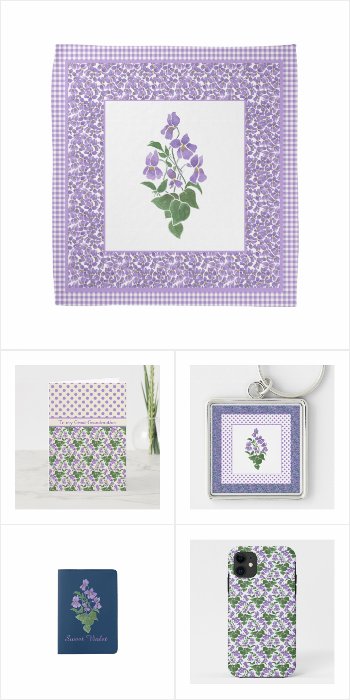
A Birthday Card or Gift with a 'Sweet Violets' pattern would certainly be special, especially as many of the cards and gifts in my 'Sweet Violets' collection are ready for you to personalize! So go ahead and choose from dozens of 'Sweet Violets' gifts and make it even more personal with your own customization. There's even a choice of 'Sweet Violets' wrapping papers, tissue giftwrap and gift bags to add the finishing touch - and don't forget that if you see a design you'd like on a different product, you can contact me through my store and I'll create what you need, at no extra charge, usually well within a couple of days.

Just click on the image below to see the full collection -


February does seem a little early to be seeing the other February Birth Month Flower - the Primrose. I associate them with springtime, but here in the UK they are usually at their best around Easter Time.

Here's my earlier blogpost about how I used to enjoy going out to the woods to pick them as a child. There is some confusion about whether we are allowed to pick wild flowers - understandably because some are becoming rare in the wild now. But this article from the Wild Flower Society - Wild Flowers and the Law - clarifies the situation and, although the wholesale digging up of wild flower plants certainly doesn't help our countryside to flourish, it's fine to pick a posy of primroses, just as it was when I was a child.

The 'Primroses' image I've used to make the repeating pattern below began as a print I made in a screenprinting class almost 30 years ago! I was living in the centre of Norwich at the time, with not many opportunities to get out into the woodland to see the little pale yellow primroses growing in the wild. But I did - and still do! - often buy the larger cultivated primroses in a variety of bold colours to brighten up my front porch in winter. I've even grown them from seed in the past, which works out a lot cheaper! Sometimes you can plant these cultivated primroses out in the garden once they've finished flowering and if they thrive there, they provide a bright spot when there's very little colour around in the gardens.


And it was from a group like these that I drew my 'Primroses' motifs for the screen print and luckily I kept the original drawing so I was able to paint them in gouache to make the repeating patterns that have become popular!


Here are just a few ideas to make someone with a February Birthday feel really special! The primrose is one of the earliest flowers to bloom but you may not know that it happens to be one of the February Birth Month Flowers. So why not celebrate a February Birthday with a special 'Primroses' Birthday Card and a gift with this pretty Primrose pattern? There's also a range of 'Primroses' gift-wrapping papers, gift bags and even matching gift tags! And you'll find an even greater selection of 'Primroses' cards and gifts if you visit the 'Painterly Florals' section of my Posh & Painterly Zazzle store.

Just click on the image below to see the full collection -

Primroses for a February Birthday
Primroses for a February Birthday  


So, whether you choose Violets or Primroses you can be sure that the Birthday Girl, whatever her age, will appreciate your Birthday Card and Gift choice!




Tuesday, 29 September 2015

Monday, 8 December 2014

Lots of Work in Progress in spite of Domestic Distractions


Last month I wrote about how my planned fortnight of relaxed creativity was blown off course by the leak in my neighbour's roof that soaked through to the wallpaper in my guest bedroom and threatened to ruin it.

I'm pleased to say that eight weeks later, it doesn't look too bad - at least in daylight the stains are hardly visible unless you know what you're looking for. Not so good in artificial light but still better than I ever thought it would be. 

But November hasn't seen much relaxation or creativity because of the wrangling over which builders to use, a problem with my garage electrics that plunged me into darkness one very wet night, no power, no light, no phone, no internet. And, as luck would have it, my mobile's battery was telling me it needed to be plugged into a charger - as if I had any sockets working to plug it into!

So with the roofing work only finishing on Thanksgiving Day and the noise that has entailed, followed by my central heating boiler malfunctioning and a blocked drain, I've been thankful for the little bit of collage I managed to complete before all these domestic interruptions stopped me in my tracks.

The Rangoli patterns have led to so many coordinating patterns that I've created about 800 products and cards for my Posh & Painterly store - and there are still some more to come. With this pattern more than any other I've made so far, I think, it's been a question of knowing when to stop and move onto something else before I get bored!


First there was the whole Rangoli, on different coloured backgrounds: that went well on cushions/pillows, as well as cloth napkins, ceramic tiles, clocks and coasters -


Then I took the centre of the Rangoli and one of the flowers and made them into a new pattern in its own right -


Next I took the floral stems and made these repeating 'mini-print' patterns:


And here's another, slightly different, one created from individual flowers from the original pattern.


Then the fun really began! 

I love discovering which patterns Mix and Match well together, to make more complex cushion designs - 


- and Smartphone Cases, many of them ready to personalize:


As if that wasn't enough playing around with my original Rangoli, I still had the border pattern to explore. I'm getting a bit faster with practice and this time, I made two alternative borders, a single row and a double one:


Here's a link to all the Rangoli gifts and greeting cards in my Posh & Painterly Zazzle store. 


But it hasn't been all about the Rangoli pattern this month. 

I made this Penguin collage a few years ago but I only used it for Christmas Cards. When I found that penguins seem to be popping up everywhere - even on the John Lewis Christmas commercial - it occurred to me that my skating penguins could extend their reach and adorn other Christmas-y clothing and gifts. So I used the Photoshop feathering tool to soften the edges and here they are, with a new lease of life:


As far as actual, away-from-the-computer art and design goes, it hasn't been easy with hammering immediately above my head in my attic studio. But I did manage to make a start on something I've wanted to do for a long while - a collage fish! Well, when it comes to sticking tiny pieces of painted tissue paper onto card, you can get a bit tired of flower petals and I thought I'd give fish scales a go instead.

Not quite finished yet, Finnegan the Fish!


I'm not sure whether I'll make other fish and sea creatures and use him as part of a repeating pattern - for shower curtains and beach-bags maybe? Or he may have possibilities as a stand-alone design; Pisces birthday cards spring to mind - or greeting cards for the Persian New Year, Nowruz.

Maybe that's something to think about for early next year? I certainly have plenty to keep me busy this side of Christmas!

So, although this has been yet another month when too many Domestic Distractions kept me from creating as many new designs as I'd planned, it has still managed to be quite productive time for me. 


Wednesday, 13 March 2013

Repeating Patterns for Painters #1

Floral Repeating Pattern made by the 'cutting up paper' method


Six months ago I began an online course in Surface Pattern Design. 
I had wanted to learn how to make repeating patterns from my floral paintings for a very long time. I wanted to make patterns that had a hand-painted look, similar to so many of the Liberty prints and the fabrics used in Monsoon clothing and accessories that I love.

I had to some extent succeeded by the ‘cutting up paper’ method, combined with some tidying up in paint.net. But I felt sure there was a better way and when I saw that making ‘technical repeats’ in Photoshop was included in the course, I thought it would be the answer. Sadly, it wasn’t.

But I did learn a few things about Photoshop – apart from the fact that it's a tremendously finickity program! – and with lots of help from fellow students, online tutorials and forums, plus three books that were Christmas gifts, I’ve finally found ways to do all the things I wanted to, ways that work!

So, with a very big thank you to all who have helped and encouraged me on this sometimes very frustrating journey, I’ve decided that over the next weeks and months, I’ll pass on what I’ve learnt.

First of all, perhaps we need to sort out what is meant by a ‘pattern’. 


The phrase ‘surface pattern’ is often used to describe any sort sort of ornamentation that decorates a plain
surface. But as I pointed out in ‘Hard-wired for Pattern-Making’,  the dictionary definitions often suggest an element of repetition. 


This is the first definition that Google provided:

pat·tern  
/ˈpatərn/
Noun: A repeated decorative design.

Verb: Decorate with a recurring design.


And I shall use the word ‘pattern’ to denote a repeating pattern or recurring motif.

We’ll begin by looking at the various types of patterns and next time I’ll give some instructions for making some of them, beginning with the simplest so that you can build your skill, post by post. I’ll be available to answer any queries and if I don’t know the answer, there’s a good chance I’ll know someone who does!


A watercolour painting that I'll use as a motif to demonstrate how to make a repeating pattern in Photoshop.


I shall assume that you have painted or hand-drawn motifs that you would like to make into a repeating patterns and that you notice and record in your sketchbook (or with a camera!) the patterns that surround us – in Nature, in buildings and so on. I shall also assume that you can’t wait to get started with learning how to make some of them into patterns for a variety of uses – fabrics, wallpapers, giftwrap and a million others!

The first thing to say is that there are many different kinds of patterns. 

There are the obvious categories, such as 'floral', 'geometric', 'ethnic' . . . some of them overlapping. And there are three classifications you may come across, with which you may not be quite as familiar. These are ‘organic’, ‘graphic’ and ‘conversational’.

A 'Geometric' pattern - but also an Islamic one, therefore it could be classified as 'Ethnic' too.

This pattern, named 'Jungle', is not truly 'Ethnic' in that it came from my imagination rather than an ethnic source. But I think it has an 'ethnic'/'tribal' feel about it!

Organic simply means a pattern that contains elements from Nature, generally with flowing, curving lines. Florals could be a sub-category of Organic but because they are so popular, Florals have a category of their own.
'Seaweed' - an example of an 'Organic' pattern
Graphic, on the other hand, indicates clean, more likely straight lines but could include curves if a floral motif is treated in a graphic way. It can often be very similar to ‘geometric’.


Although the motif for this 'Jungle' pattern was hand-drawn and the motifs are arranged  to represent flowers, it is the nearest I have come to a 'Graphic' style.

'Conversational' is a strange way to describe patterns that use motifs that don’t really fit into the other categories. It could be a little ‘character’ or object, anything from bunnies to boats to buses!  It’s not an area I have explored much as yet but here is one that I did as coursework:

I put two motifs together for this exercise in 'Conversational' patterns - both the frog and the water lily stand alone as hand-painted greeting cards.

In the next in this series of ‘Repeating Patterns’ posts, I’ll cover the most common types of repeats, together with instructions for how to create the most straightforward one in Photoshop.

Meanwhile, here’s a list of basic things you’ll need to know how to use or, at least, how to find in Photoshop:

1. Open/Close File. Open New File to the size you want. Resize: canvas size.
2. Show/Hide Grid, snap to grid. Guides – how to use them, Snap to guides.
3. Colour palette – how to swap background/foreground colours.
4. Cascade Windows. (Windows > Arrange >Cascade) Show Layers, History, Colours.
5. Change the % view of your open window. Fit to screen.
6. Layers – hide/unlock. Send to back/front (under Layers > Arrange)
7. Adjust Tolerance/Opacity/Brush Size
8. Tools: Move, Rectangle, Crop, Clone Stamp, Paint Bucket, Magic Wand, Gradient Tool, Ink
        -dropper tool, Text tool.

And please, don’t be afraid to ask if you don’t understand something I’ve written or if you have a question that I haven’t covered. 


Together we’ll make some glorious painterly patterns!


As an experiment, I've made this post into a .pdf file that I'm hoping you can download if you're interested in keeping these 'how to' posts -

Click
to download a .pdf of this post, 
condensed into 4 pages
 in case you want to print it out.


Thursday, 29 November 2012

From Greeting Cards to Repeating Patterns . . .

A few days ago, a customer ordered three of the coffee mugs in my Zazzle store. I was over the moon!

I didn’t make a huge amount of money from the sale and it was just one sale among many at this time of year. But it meant an awful lot to me because the three mugs were ones I had created with my repeating floral patterns earlier this year.

So the sale came as a kind of affirmation that I’m on the right track in shifting my main focus away from greeting cards towards pattern making. And as well as that, my own reaction showed me that the bold floral patterns are my first love – which is probably a helpful pointer in determining my ‘signature style’.

Over the course of the past ten years, I’ve gone from Fine Art – my pastel paintings – to greeting cards – to repeating pattern design and I feel I have finally homed in on what I love to create the most.

I do enjoy designing greeting cards but I absolutely love creating patterns! I find it quite addictive – I just wish my technical knowledge could keep up with my enthusiasm!

One of the things I find difficult about creating greeting cards is that I really dislike cards with verse inside, particularly if it is ‘sentimental’. And unfortunately it seems that there are many customers for whom the ‘verse’ is just as important as the artwork.


As I wrote in an earlier blog post, I prefer to let the design do the talking, conveying the sentiments more subtly through the image. And while that suits plenty of people, it also excludes many potential customers for my cards.

To my great relief, there is no ‘verse’ to worry about in Pattern Design! It’s simply a case of putting together shapes, lines and colours in a pleasing way . . .

 
. . . or is it?

Many years ago, when I first discovered William Morris and the Arts & Crafts Movement, I read something to the effect that a pattern should always evoke a feeling, recreate an atmosphere, transport the beholder to a place they would like to be. I have searched the internet in vain, trying to find the exact quote. But the gist of it has always stayed with me.

So, in a way, a pattern carries just as much of a message as a greeting card. It just does it in a much more subtle, sometimes almost subliminal, way.

But there’s nothing very subtle about flowers, which I must admit form the basis of most of my designs to date. Most of us love gardens and flowers and in the case of a city flat-dweller, a floral blind or coffee mug may be the nearest they get to a garden on a day-to-day basis. And that provides me with the motivation to keep on working – or, more accurately, playing – with the constantly inspiring ‘source-book’ that Mother Nature provides!

Pretty Spring Primroses Bone China Coffee Mug, Porcelain Mug
Pretty Spring Primroses Bone China Coffee Mug, Porcelain Mug by helikettle


What feelings do floral patterns (not necessarily mine!) evoke in you?