Showing posts with label violets. Show all posts

Thursday, 21 January 2016

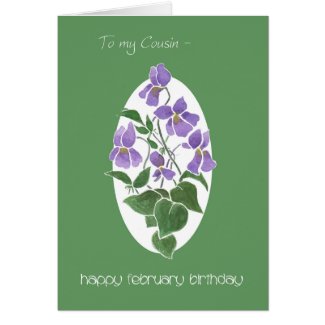
Primroses and Violets for a February Birthday


Finding a different birthday card for a friend or relative, year after year, can be a challenge, especially if we're looking for something that will be special to that person.

I've just been ordering birthday cards for my friends and trying to remember which ones I sent them last year! 

Of course it helps that so many of the cards we can buy online can be personalized. It's not difficult to do and yet it can make a big difference because the recipient will know that we didn't just rush out to the nearest store and pick up the first card we found!

A 'photo card' is another option - slightly more complicated to create but not too daunting, especially once you've done it a few times.

And here's another idea - take advantage of the 'Birth Month Flowers'! Each month has at least one well-known flower designated to it. You can read about them on this website. Some of the suggested flowers seem completely out of season for me, here in the UK.

But both of the February Birth Month Flowers, the Violet and the Primrose, are very familiar to me and relate to the right time of year - more or less!


I have plenty of wild violets in my front garden! When I first moved into my house, I tried to get rid of them to make room for the flowers I wanted to plant. But because a quite rapidly growing Magnolia Tree spreads its roots throughout the garden, it was a losing battle. So I gave up and allowed my front garden to become a 'woodland' area with the only plants that enjoy the shade and the poor soil - mainly bulbs, lilies of the valley and the violets! The lilies of the valley are gradually spreading from one side and the violets from the other and they almost meet in the middle and I'm wondering which will win when they eventually meet!

Here's a webpage about 'How to Grow Wild Violets'  - not that mine have needed any help from me; they manage pretty well all by themselves. But I didn't know that they are edible until I read this article.


As I wrote in this earlier blog post, these little Wild Violets don't add a lot of colour to a garden, especially where they are often almost hidden amongst the fallen leaves. It was only on closer inspection for the purposes of painting them, that I 'got to know them' and began to appreciate them. They certainly live up to their description of 'Shrinking Violets', another of my earlier blog posts!


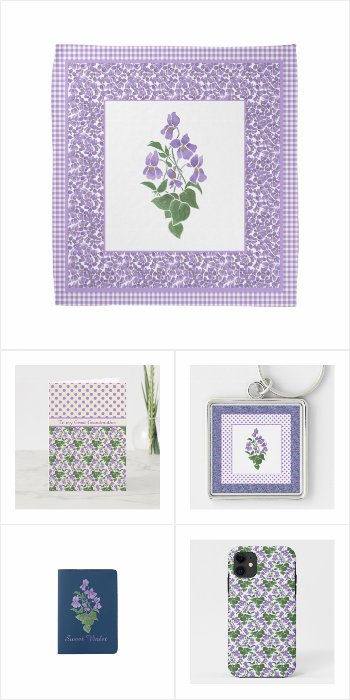
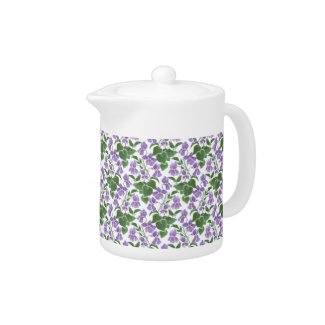
A Birthday Card or Gift with a 'Sweet Violets' pattern would certainly be special, especially as many of the cards and gifts in my 'Sweet Violets' collection are ready for you to personalize! So go ahead and choose from dozens of 'Sweet Violets' gifts and make it even more personal with your own customization. There's even a choice of 'Sweet Violets' wrapping papers, tissue giftwrap and gift bags to add the finishing touch - and don't forget that if you see a design you'd like on a different product, you can contact me through my store and I'll create what you need, at no extra charge, usually well within a couple of days.

Just click on the image below to see the full collection -


February does seem a little early to be seeing the other February Birth Month Flower - the Primrose. I associate them with springtime, but here in the UK they are usually at their best around Easter Time.

Here's my earlier blogpost about how I used to enjoy going out to the woods to pick them as a child. There is some confusion about whether we are allowed to pick wild flowers - understandably because some are becoming rare in the wild now. But this article from the Wild Flower Society - Wild Flowers and the Law - clarifies the situation and, although the wholesale digging up of wild flower plants certainly doesn't help our countryside to flourish, it's fine to pick a posy of primroses, just as it was when I was a child.

The 'Primroses' image I've used to make the repeating pattern below began as a print I made in a screenprinting class almost 30 years ago! I was living in the centre of Norwich at the time, with not many opportunities to get out into the woodland to see the little pale yellow primroses growing in the wild. But I did - and still do! - often buy the larger cultivated primroses in a variety of bold colours to brighten up my front porch in winter. I've even grown them from seed in the past, which works out a lot cheaper! Sometimes you can plant these cultivated primroses out in the garden once they've finished flowering and if they thrive there, they provide a bright spot when there's very little colour around in the gardens.


And it was from a group like these that I drew my 'Primroses' motifs for the screen print and luckily I kept the original drawing so I was able to paint them in gouache to make the repeating patterns that have become popular!


Here are just a few ideas to make someone with a February Birthday feel really special! The primrose is one of the earliest flowers to bloom but you may not know that it happens to be one of the February Birth Month Flowers. So why not celebrate a February Birthday with a special 'Primroses' Birthday Card and a gift with this pretty Primrose pattern? There's also a range of 'Primroses' gift-wrapping papers, gift bags and even matching gift tags! And you'll find an even greater selection of 'Primroses' cards and gifts if you visit the 'Painterly Florals' section of my Posh & Painterly Zazzle store.

Just click on the image below to see the full collection -

Primroses for a February Birthday
Primroses for a February Birthday  


So, whether you choose Violets or Primroses you can be sure that the Birthday Girl, whatever her age, will appreciate your Birthday Card and Gift choice!






Thursday, 20 March 2014

The Arrival of Spring and with it the Golden Daffodils

Top right: my watercolour daffy-down-dillies pattern
Bottom row: all the various coordinating patterns
Top left my faux-patchwork pattern using the original desing and some of the coordinates


So now we’re well into March and Spring is definitely well underway here in South-East Wales! 


Lesser Celandine springing up everywhere at the moment -
these are nestled at the foot of one of the mature trees in
Bailey Park, just across the road from me.

A couple of questions have been on my mind and searching the internet has only provided me with partial answers. Maybe you can help me out with the second one?


Forsythia in my rather wild
front garden


Question 1 – why are so many of the early spring flowers yellow? 

There are primroses, crocuses, forsythia and of course, the 'host of golden daffodils' that Wordsworth celebrates!


A Google search quickly revealed that bees and other flying insects are attracted to yellow and that helps the plants to pollinate and ensure the survival of the species. (Later in the year, when flowers are more multi-coloured, the centres, where the pollen is held, are still invariably yellow).

This also answers the question of why my yellow crocuses are pecked to death by the birds, whereas the purple ones are left free to grow undisturbed – the birds are after the insects that were attracted to the yellow flowers!

Here you can see the damaged remains of the
yellow crocuses in contrast to the thriving purple ones!


But I couldn’t find an answer to my second question –

Question 2 – why are the yellow flowers normally followed by blue and purple ones? 

Voilets, bluebells, purple crocuses, harebells, irises - and of course this wonderful purple Aubretia, that has escaped from my garden and attached itself to the huge hedge of evergreens that runs down the side of my house.


My runaway Aubretia thrives on the outside of my hedge where it gets plenty of sun.
Don't you just love flowers that spread outside of their boundaries, sharing
their loveliness with passers-by! (I'm training my climbing roses and honeysuckle to do that too.)


I'm sure Mother Nature has her reasons for blue to follow yellow! 

Anybody know the answer?


iPod Touch 4g Case to Personalize Faux Patchwork iPod Case-Mate Cases

 
Click
to browse more
Daffy-down-Dillies
gifts and greeting cards

Thursday, 20 February 2014

Are you a Shrinking Violet?


The Violet is one of the Birth Month Flowers for February.

Poems about violets often refer to them as blooming in April and Yardley even have a range by the name of "April Violets". I shall keep a close eye on my front garden this year and notice when the violets start to bloom. 

What is the word that we most often hear in connection with violets? 

There’s the African Violet, the Dog Violet and the Parma Violet – the one that is sometimes used in confectionery and cake decoration - 

And of course there’s the ‘Shrinking Violet’.

Not because it can literally shrink – though when exposed to too much sun, it may shrivel up and die.

‘Shrinking’ in this case is another way of expressing modesty, humility or even shyness, human traits that have often been associated with violets because of their habit of hiding away in woodlands, close to the ground and often hidden by leaves.


Violet motif for the
repeating pattern.
Poems suggesting these qualities in the pretty little wild wood violets abound! Here's a selection.

While modesty and humility are surely positive qualities, shyness isn’t necessarily a good thing. It has been suggested that shyness is the result of too much preoccupation with oneself and how one appears to the rest of the world. And it can certainly hold us back from becoming all that we’re capable of becoming.

I’ve been a ‘Shrinking Violet’ in my time – until a very wise elderly relative pointed out to me that my ‘walking small in order that others may walk tall’ was not serving any good purpose!

But when I was looking up quotes about violets I came across one that stood out from the rest and I think it’s my favourite. It doesn’t deny that violets are not particularly showy; they don’t grab our attention like the daffodils and tulips that flower around the same time.


But they are tenacious! And there's power in that tenacity – as I discovered when I first dug over the ground beneath my Magnolia tree. 


'Tile' for the
repeating pattern.
When I moved into my house, there was grass beneath the tree but it wasn’t a pretty sight. It didn’t get enough light and it was impossible to mow because of the roots of the tree, even though I bought a strimmer especially for the purpose. Hence my decision to dig it all up and make a wild, woodland area of my front garden.

As I dug out the grass and the dandelions, I began to see the violets hiding closer to the ground. I was planning to scatter wild flower seeds in the soil so I dug out the violets as well – with some difficulty because of their long, enormously strong roots! 

But now, ten years later, the ground is covered in violets again! 

So whenever I have time in the autumn, I plant daffodils and irises around the tree, removing just a few of the violets to make room for them. As the tree has grown over the years, it has become harder and harder for anything else to grow beneath it – except for the violets! 

So maybe the violets are telling us something, especially those of us who are introverts by nature. Perhaps their lesson is that we don’t need to put on a show, to draw attention to ourselves in order to be purposeful. 

As the quotation suggests – and as I discovered in my front garden! – tenacity and modesty, strength and humility can happily rub along together!


Please feel free to pin or download and print
 this 300 dpi image (for your personal use only).


PS I recently discovered that the Violet is associated with Mother's Day.

Originally known as Mothering Sunday, it fell on the fourth Sunday in Lent and in the 16th Century, it was the occasion for everyone to visit their 'Mother Church', ie their nearest large church of cathedral, for a special 'Mothering Sunday' service.

Later, the idea of honoring all mothers on that same date meant that domestic servants were given a rare day-off to visit their mother church or, more often, to go home to visit their mothers, whom they probably hadn't seen for months or even as long ago as the previous Mothering Sunday. The servants would gather a posy of wild flowers along the way and the most prevalent wild flower at that time of year was, yes, you've guessed it - the violet!

This year, Mothering Sunday (or Mother's Day) falls on Sunday, 30th March in the UK.


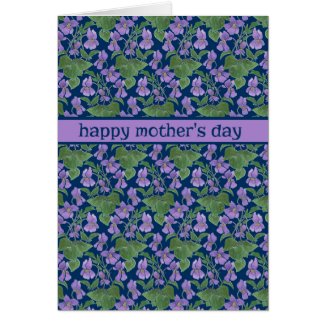
There are plenty of Mother's Day greeting cards and gifts to choose from in my Zazzle stores but here's a link to the cards that feature the Violets.


Thursday, 6 February 2014

February Birth Month Flower - Violet


I’ve never much liked violets. 

I tend to prefer bright, colourful flowers like Pot Marigolds and Daffodils. By comparison, I always thought of violets as rather drab and dreary, too much leaf for such tiny flowers and anyway, purple is by no means my favourite colour, especially in the garden. I tend to think of Violet in particular as an 'old lady' colour . . . 

But I’ve noticed that when I draw flowers for painting or for making a pattern, it feels as if I get to know them. It’s almost like getting to know a person, like making a new friend.

And that’s exactly how it was with the violets I needed to paint for a new series of February Birth Month Flower Birthday Cards!


In fact, even before I’d made the violets into a birthday card design, my enthusiasm had grown so much that I began to make ‘Violets’ repeating patterns and coordinates to create all sorts of pretty products for my Posh & Painterly store!


I made my patterns using Photoshop and if you’re interested in how to do it, you’ll find some easy to follow instructions HERE, on some of my blogs from 2013. 

The main violet pattern was based on an ogee-shaped repeat, instructions in #4. But if you’re a newcomer to repeating patterns, you’ll probably benefit from starting with #1 and working your way through.


If you don’t have Photoshop, don’t despair! 

I made some of my best and most popular repeating patterns, such as this one, using paper, paint, scissors and sticky tape! 


I found the very clear instructions for making repeating patterns without a computer on another blog, Design Sponge .

Good luck with this - but just think carefully before you get into making repeating patterns - you may easily find yourself getting addicted like I am!